WELCOME TO CRASH COURSE
Crash Course is one of the best ways to educate yourself, your classmates, and your family Online.
Is Crash Course worth watching?
'Crash Course' has nothing new to offer in terms of insights. One thing that remains.
All in all, this crash course isn't mandatory, but it is well worth taking once!
A valve is a device or natural object that regulates, directs or controls the flow of a fluid (gases, liquids, fluidized solids, or slurries) by opening, closing, or partially obstructing various passageways. Valves are technically fittings, but are usually discussed as a separate category. In an open valve, fluid flows in a direction from higher pressure to lower pressure. The word is derived from the Latin valva, the moving part of a door, in turn from volvere, to turn, roll.
The simplest, and very ancient, valve is simply a freely hinged flap which swings down to obstruct fluid (gas or liquid) flow in one direction, but is pushed up by the flow itself when the flow is moving in the opposite direction. This is called a check valve, as it prevents or "checks" the flow in one direction. Modern control valves may regulate pressure or flow downstream and operate on sophisticated automation systems.
Valves have many uses, including controlling water for irrigation, industrial uses for controlling processes, residential uses such as on/off and pressure control to dish and clothes washers and taps in the home. Even aerosol spray cans have a tiny valve built in. Valves are also used in the military and transport sectors. In HVAC ductwork and other near-atmospheric air flows, valves are instead called dampers. In compressed air systems, however, valves are used with the most common type being ball valves.
https://www.iqsdirectory.com/articles/check-valve.html

Swing Check Valves:
A swing check valve is a self actuated valve that serves as a backflow preventer or one direction valve. They have a disc that swings on a hinge off the seat of the valve to allow forward flow. When the flow stops, it swings back into position to stop reverse flow. The weight of the disc has to be sufficient to withstand the impact of the return flow. Swing check valves have less turbulence and low pressure drop.
Lever and weight swing check valves are used when there is a chance of water hammer while ones with lever and spring are used in high pressure and high flow velocity applications. Regardless of the type of swing check valve, their disc needs to be checked and cleaned regularly.
Swing Check Valve - Diagram, Types, and Applications
https://qrcvalves.com › swing-check-valve
A swing check valve allows fluid to travel only one way through a pipeline. When installing a swing check valve make sure the hinge is at the top so gravity helps keep it closed.

Cross-sectional diagram of an open globe valve.
- body
- ports
- seat
- stem
- disc when valve is open
- handle or handwheel when valve is open
- bonnet
- packing
- gland nut
- fluid flow when valve is open
- position of disc if valve were shut
- position of handle or handwheel if valve were shut


Air-actuated control valves each with a 4–20 mA "I to P" converter integral to a valve positioner. In this example each positioner is comparing the valve stem travel against control signal, and applying any correction.

What is a P&ID or flow diagram?
P&IDs show how industrial process equipment is interconnected by a system of pipelines. P&ID schematics also show the instruments and valves that monitor and control the flow of materials through the pipelines. Process flow diagrams. PFDs show how industrial process equipment is interconnected by a system of pipelines.
https://www.edrawsoft.com/pfd-pid-comparison.html
Create a P&ID or PFD
- Piping and instrumentation diagrams
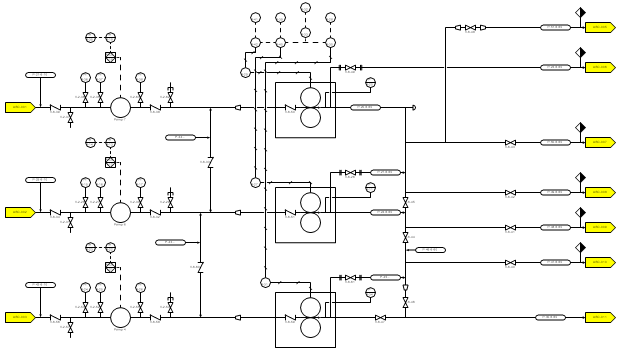
- Process flow diagrams PFDs show how industrial process equipment is interconnected by a system of pipelines. A PFD is more conceptual than a P&ID, and usually includes more annotations that display data.
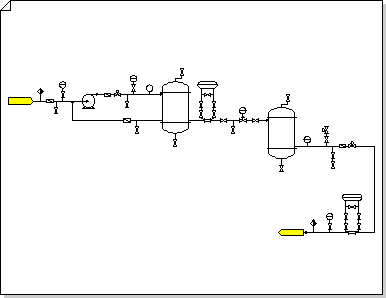
Create a piping and instrumentation diagram
- In Visio, open any of the following templates:
- Piping and Instrumentation Diagram
- Process Flow Diagram
- From any of the Equipment categories, drag equipment shapes onto the drawing page.An intelligent tag number for each component appears on the diagram.
- Use pipelines to connect major equipment.
- Drag a pipeline shape from Pipelines onto your drawing page, and then position one of its endpoints on an equipment shape. You can connect a pipeline to any point on the outside of an equipment shape, even if the shape has no connection point there.The endpoint of the pipeline turns green to indicate that it is connected (glued) to the equipment shape, and a connection point is created if one did not exist.
- Drag the other endpoint to another equipment shape.
- To change the appearance or show the flow direction of a pipeline, select the pipeline, and then select a style from the Line option on the ribbon (see Shape Styles group on the Home tab).Styles control the thickness of the line, directional arrows, and other graphic symbols that indicate the type of pipe or instrument line.Tip: You can also use the Connector
 (located in the Home tab, Tools group) to draw pipelines. This method is particularly useful when you work in large diagrams that have many connections. Click Connector and then on Pipelines, click the pipeline shape you want to use. Then draw the pipeline in your diagram. To change the type of pipeline, simply click a different pipeline shape on Pipelines and continue working in your diagram.
- Add valve shapes.
- From Valves and Fittings, drag valve shapes on top of pipelines. Release the mouse button when a green square appears, indicating that the valve is glued to the pipeline.When a valve is added to the pipeline:
- It automatically rotates to the same orientation as the pipeline.
- It splits the pipeline into two identical pipelines, each of which is glued to the valve.
- To delete a valve from a pipeline, select the valve and press DELETE.When a valve is deleted, a single pipeline replaces the split pipeline.
- From Valves and Fittings, drag valve shapes on top of pipelines. Release the mouse button when a green square appears, indicating that the valve is glued to the pipeline.When a valve is added to the pipeline:
- From the Instruments category, drag instrument shapes onto the drawing page near the pipeline, valve, or equipment they monitor.
- Reposition shapes in the diagram by dragging them.
- You can now add data to components, or create and apply property sets. Follow these steps for more information:Add data to components
- On the Data tab, click Shape Data Window.
- On the drawing page, select the shape to which you would like to add data.
- Click in each shape data field, and type or select a value.
- Do one of the following:
- To add the property set to shapes on a drawing, select the shapes.
- To add the property set to shapes on a stencil, select the shapes on the stencil.
- On the Data tab, click Shape Data Window.
- Right-click on Shape Data Window and select Shape Data Sets.
- Click Add, and then type a name for the shape data set.
- Choose whether to create a new shape data set, a set based on the currently selected shape, or a set based on an existing shape data set, and then click OK.
- To add or modify shape data, in the Shape Data Sets dialog box, select the shape data set and click Define.
- In the Define Shape Data dialog box, make any necessary modifications.
- Click OK.
- Renumber components.
- On the Process Engineering menu, click Renumber.
- In the Renumber Components dialog box, under Apply to, select the option whether to renumber the components in the document, current page, or in the current selection.
- In the Include tag formats list, clear the check boxes for the tag formats that you don't want to include in the renumbering.Note: By default, all tag formats are selected.
- Assign a starting value and an interval value for renumbering. You can assign a different start value and interval value to each tag format.
- Click an item in the Include tag formats list to highlight it.
- In the Starting value box, type or select the starting value for renumbering.
- In the Interval box, type or select the increment used to renumber the components.
- Repeat these steps for each tag format.
- Click OK .
- Generate lists or bills of materials of equipment, pipelines, valves, and instruments.
- On the Review tab, click Shape Reports.
- Follow these steps to create a custom report definition, or, skip to step c. to use an existing report definition.The following steps create a report definition that filters out duplicate process engineering shapes and reports on process engineering components.
- In the Report dialog box, click New.
- In the Report Definition Wizard, choose an option you want to report on, and click Advanced.
- In the Advanced dialog box, in the Property list, select PEComponentTag. In the Condition list, select Exists.In the Value list, select TRUE.
- Click Add to put this condition in the defined criteria list, and then click OK.
- In the Report Definition Wizard, click Next.
- Select the <Displayed Text> check box to report on the component tag. Then select the check boxes for other data you want to report on, and then click Next.
- To filter out duplicate process engineering shapes and report on components, click Subtotals.
- In the Subtotals dialog box, in the Group by list, click <Displayed Text>, and then click Options.
- In the Options dialog box, click Don't repeat identical values, and then click OK twice.
- In the Report Definition Wizard, click Next, enter the information to save your report, and then click Finish.
- In the Report dialog box, you can either run the report or click OK to save your definition and run it later.Tip: To create a new report definition based on an existing one, in the Report dialog box, select the existing definition, and then click New. Save the modified report definition with a new name.
- In the Report Definition list, click the name of the report definition you want to use.The report definition determines which shapes are reported on and which shape data are included in your report.
- Click Run, and then in the Run Report dialog box, click the report format you want, and then do one of the following:
- If you are saving your report as a shape on the drawing, choose whether to save a copy of the report definition with the shape or link to a report definition.
- If you are saving your report as a file (when you select HTML or XML as report format), type a name for the report.
- To generate the report, click OK.
- If you ran a custom report, when you return to the Report dialog box, click OK to save your definition.
=================
What should I use instead of Visio?
Here's a list of 6 Visio alternatives (both paid and free) to help you create professional-looking diagrams in minutes:
- Visme.
- Draw.io.
- Lucidchart.
- SmartDraw.
- OmniGraffle.
- Google Drawings.
Visio Alternative | Lucidchart - Easy-To-Read Diagrams
Save Time and Avoid Rework By Moving Over To Our Free Visio Alternative Hassle Free. Use Lucidchart To Visualize Ideas, Make Charts, Diagrams and More. Over 10,000,000+ Users. For PC, Mac, and Linux. Seamless Integrations. Intuitive. Nothing to Install.
Lucidchart lets you create both simple and complex diagrams in minutes with easily customizable templates, hundreds of drag-and-drop shapes, and collaborative features. It's the perfect cloud-based Microsoft Visio online alternative for every user, every industry, and every budget.
AutoCAD P&ID
AutoCAD P ID software allows you to create, modify, and manage schematic piping and instrumentation diagrams. AutoCAD Plant 3D adds 3D models, including piping, equipment, support structures, generation of isometric, and orthographic drawings. AutoCAD Plant 3D includes the features of AutoCAD P ID.
Process Specialist Salaries in Canada
Process Specialist Salaries
| Job Title | Salary |
|---|---|
| Besnovo Process Specialist salaries - 3 salaries reported | $75,453/yr |
| BMO Financial Group Process Specialist salaries - 3 salaries reported | $79,203/yr |
| Hatch Process Specialist salaries - 2 salaries reported | $118,454/yr |
https://www.glassdoor.ca/Salaries/process-specialist-salary-SRCH_KO0,18.htm
Job Title: Controls Specialist/Engineer
Job Location: Ajax, ON Job
Field: Engineering Employment
Type: Full Time – Permanent
Besnovo (formerly BRIC Engineered Systems) is a leading system integrator in industrial robotics and automation and has a track record of developing sophisticated robotic solutions and systems for the aerospace, automotive, and advanced manufacturing industries. Besnovo’s robotic and automation products have been successfully deployed for worldwide customers, including the US Air Force and leading aerospace companies. Besnovo is seeking an experienced controls engineer/specialist to lead the development of electrical and control modules of automatically guided vehicles (AGVs) and to support the development of electrical and control modules of industrial robotic systems. The successful candidate will report to the CTO at Besnovo and will work with a multi-discipline team to develop mobile robotic systems for industrial...
AutoCAD Sample Drawings


No comments:
Post a Comment